
Since people started looking for goods and services online, businesses have focused on getting found on Google. But as more consumers turn to AI to research products, compare services and make purchasing decisions, the way businesses need to approach their marketing is changing.
In fact, a recent report from PwC New Zealand, The AI-powered consumer: How shopping behaviour is changing in New Zealand, provides some interesting insights into just how quickly this shift is happening.
PwC surveyed 1,000 New Zealand consumers who had used AI as part of their shopping journey in the previous 12 months.
Among those surveyed:
-
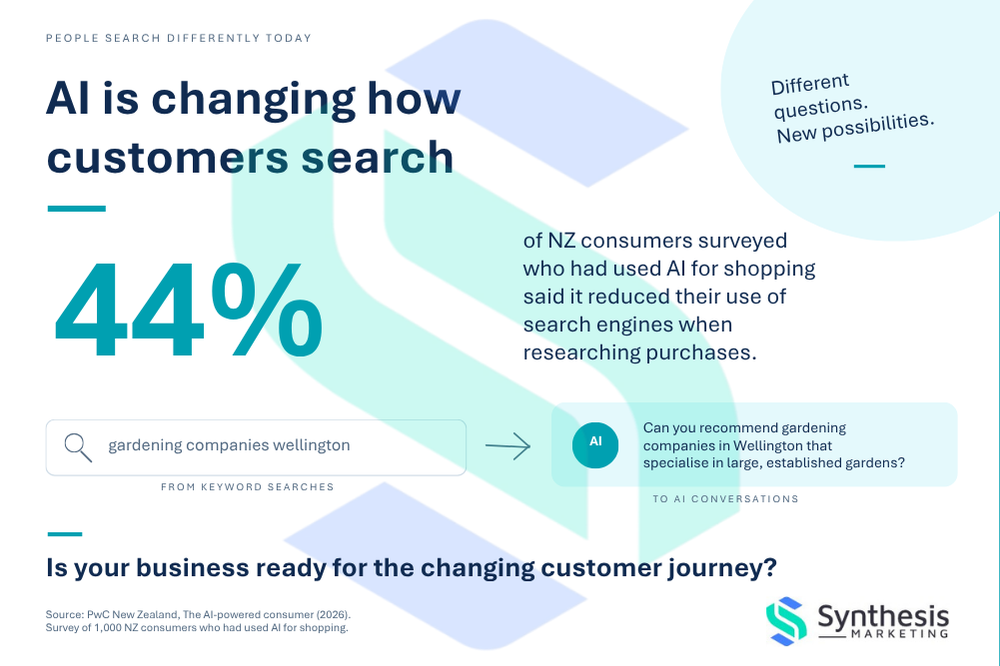
- 44% said using AI had reduced their use of search engines when researching purchases.
- 64% were using AI to compare products and prices.
- 62% were using AI to research planned purchases.
- 31% were comfortable allowing an AI agent to complete purchases on their behalf.
The findings reinforce something we have been increasingly focused on at Synthesis: businesses need to think beyond traditional digital marketing and consider how they are being discovered and represented through AI.
The way customers search is changing
Think about how someone might traditionally research a product or service.
They might search Google, visit several websites, read reviews, compare options and eventually make contact with a business.
However, AI is beginning to change that process.

Instead of searching for individual businesses and doing all the research themselves, customers can now ask ChatGPT or another AI platform to help them identify suitable options.
For example:
“I’m looking for a Wellington gardening company that specialises in maintaining large, established gardens. Who should I consider?”
Or:
“What are the best options for a New Zealand business wanting to reduce its energy costs?”
AI can bring together information from multiple sources, compare businesses and present customers with a shortlist of options.
This creates an important new challenge for businesses.
It’s no longer just about whether your website appears in Google. It’s also about whether AI understands what your business does, who you help and why someone should choose you.
Does this mean SEO is dead?
Absolutely not.
Search engines remain an important part of how customers find businesses. In fact, PwC’s research found that search engines were still the most-used product research channel among the AI-shopping consumers surveyed.
However, traditional Search Engine Optimisation (SEO) is now only part of the picture.
Businesses also need to consider Artificial Intelligence Optimisation (AIO), sometimes referred to as Generative Engine Optimisation (GEO).
-
- SEO focuses on improving visibility in search engine results
- AIO focuses on helping AI platforms find, understand and accurately represent your business when responding to customer questions.
Importantly, here is considerable overlap between the two.
A well-structured website, relevant content, clear information about your services and strong online credibility all contribute to both SEO and AIO.
The difference is that businesses now need to consider how their information will be interpreted and used by AI, rather than focusing exclusively on how individual pages rank in search results.
What does this mean for your marketing?
At Synthesis, we see several important areas businesses should be considering as they review their marketing strategies.
1. Make sure your website clearly explains what you do
Many business websites are written primarily to promote the business, rather than answer the questions potential customers are asking.
AI makes it even more important to have clear, useful content that explains:
-
- What products or services you provide.
- Who your products or services are designed for.
- The problems you help customers solve.
- What makes your business different.
- Where you operate and who you work with.
Think about the questions your customers ask during an initial enquiry or sales conversation.
Does your website answer them?
2. Build your online credibility
AI platforms can draw on information from a range of online sources when researching businesses.
Your website remains important, but customers and AI platforms also need to find information about your business elsewhere online. For this reason, your wider digital presence matters.
Google Business Profiles, customer reviews, relevant business directories, industry websites, case studies and other credible online references can all contribute to your wider digital presence.
The objective is to build a consistent and trustworthy picture of your business across the internet.
The big takeaway here is to make sure that all the information about your website, especially contact details, address etc., is the same everywhere people can find it
3. Create content that demonstrates your expertise
Generic marketing content is becoming less valuable. Interestingly that means that marketing created by, or with AI ranks less well for AIO.
Businesses need to provide useful information that demonstrates genuine knowledge and experience.
This might include:
-
- Case studies showing how you have helped customers.
- Articles answering common customer questions.
- Practical advice relevant to your industry.
- Detailed information about your products and services.
- Examples of your work and customer outcomes.
The aim is not simply to produce more content. It is to produce content that helps customers make informed decisions and gives AI platforms useful information about your business.
4. Understand how AI currently represents your business
Have you tried asking ChatGPT what it knows about your business?
Or asking it to recommend businesses in your industry or location?
This can be an interesting starting point.
You might discover that your business is missing from relevant recommendations, that the information presented is incomplete or that competitors are being mentioned more frequently.
One AI response isn’t a reliable measure of overall visibility, but testing a range of relevant customer questions can help identify areas worth investigating and remedying.
5. Review your wider marketing strategy
Perhaps the most important point is that AI should not be considered in isolation.
It needs to become part of your wider marketing strategy.

Your website, SEO, content marketing, social media, business listings, customer reviews and other marketing activities all have a role to play in building your online presence.
The challenge is understanding how these activities work together to help your business get discovered, build credibility and generate enquiries or sales.
The opportunity for New Zealand businesses
PwC’s research focuses primarily on consumer shopping behaviour, but we believe the implications extend well beyond retail.
Whether you are a professional services firm, trades business, tourism operator, manufacturer or retailer, the way potential customers research and compare businesses is evolving.
Not every industry or sector will experience the same changes at the same pace. However, businesses that understand how their customers use AI will be better placed to adapt their marketing accordingly.
At Synthesis, we have been incorporating AIO into our website reviews, SEO programmes and wider digital marketing strategies to help clients respond to these changes.
The fundamentals of good marketing haven’t changed. Businesses still need to understand their customers, communicate their value and build trust. What is changing is how customers discover that information.
And that’s why AI needs to be part of the marketing conversation.
Source: PwC New Zealand, July 2026 – The AI-powered consumer: How shopping behaviour is changing in New Zealand.